
People leave hospital after a stroke at very different points. One person stands with a hand on the wall. Another needs help to roll in bed. NHS stroke care treats rehabilitation as part of treatment, and the World Health Organization describes rehabilitation as support for everyday function. Neither source offers a calendar that says where someone "should" be by a certain week.
Recovery is uneven. A better morning can be followed by a tiring afternoon. Speech may return in fragments while the hand stays clumsy, or the opposite. Comparing the person with a neighbour who had a stroke last year adds pressure and very little information. The useful comparison is with this person's own last week, using the goals the hospital wrote down.
Protect the weak shoulder
The weak arm needs support. It does not need to be used as a handle. To sit the person up, roll them toward the stronger side if the ward taught that method, let them push through the stronger arm if they can, and bring the weak arm across the body so it is not left behind and pulled on. Do not pull the weak arm to sit the person up.
A weak shoulder can slip partly out of its comfortable resting position and become painful. Hanging the arm off the edge of a bed or letting it dangle during a transfer makes that more likely. When they sit, rest the forearm on a pillow or the arm of a chair so the hand is not lower than the elbow, unless the therapist has shown a different position.
Pain in that shoulder is a reason to tell the treating team. Forcing the arm overhead because it "should keep moving" can inflame a joint that is already poorly protected by weak muscles. Range and support are therapy decisions.
Use the positioning the hospital showed
Before discharge, ask a nurse or therapist to show positioning in the place the person will actually lie. Many people at home sleep on a floor mattress. The pillow arrangement that worked on a high hospital bed may need a fresh demonstration there: where the weak arm rests, how the trunk is supported, and how to turn without dragging the shoulder.
Write the sequence in a few lines while the demonstration is still in front of you. Night carers and day carers often differ, and a photo of the position, taken with the therapist's agreement, prevents a slow drift back to pulling on the arm.
Change position often enough to protect the skin, on the schedule the ward recommended. Pain, redness that does not fade, or a damp patch of skin needs attention the same day. Rehabilitation and skin care run together when someone spends long hours in one posture.
Practice ordinary tasks
Standing up, washing the face, putting on a shirt, or stepping to a commode are often more useful than a gadget bought online. Therapists call this task practice because the nervous system is being asked to repeat the activity the person needs. A plastic device that flashes when a hand squeezes it can be a supplement only if the therapist has chosen it. It does not replace the morning wash.
Keep the task inside what the person can almost do. If standing with one person helping is the current level, the session is that stand, done with the method already taught. Adding a second helper to force a walk the therapist has not cleared turns practice into a lift.
Fatigue is part of stroke. A short practice when the person is alert beats a long one that ends in slumped sitting and a painful shoulder. Stop if they become much more breathless, dizzy, or distressed, or if pain in the shoulder jumps.
Stroke warning signs sets out how to recognise a new stroke. A person who has already had one can have another. Do not wait for the next therapy visit to see whether a new face droop, speech change, or loss of movement "settles."
Swallowing is a separate problem
Coughing on drinks, a wet-sounding voice, or food sitting in the cheek can mean swallowing is unsafe. That needs its own assessment. Movement practice does not test the swallow, and a relative should not offer sips "to see." Speech and swallowing after stroke explains why a quiet cough-free meal can still be unsafe, and why speech changes and swallow changes are assessed on their own terms.
Who else comes to the house
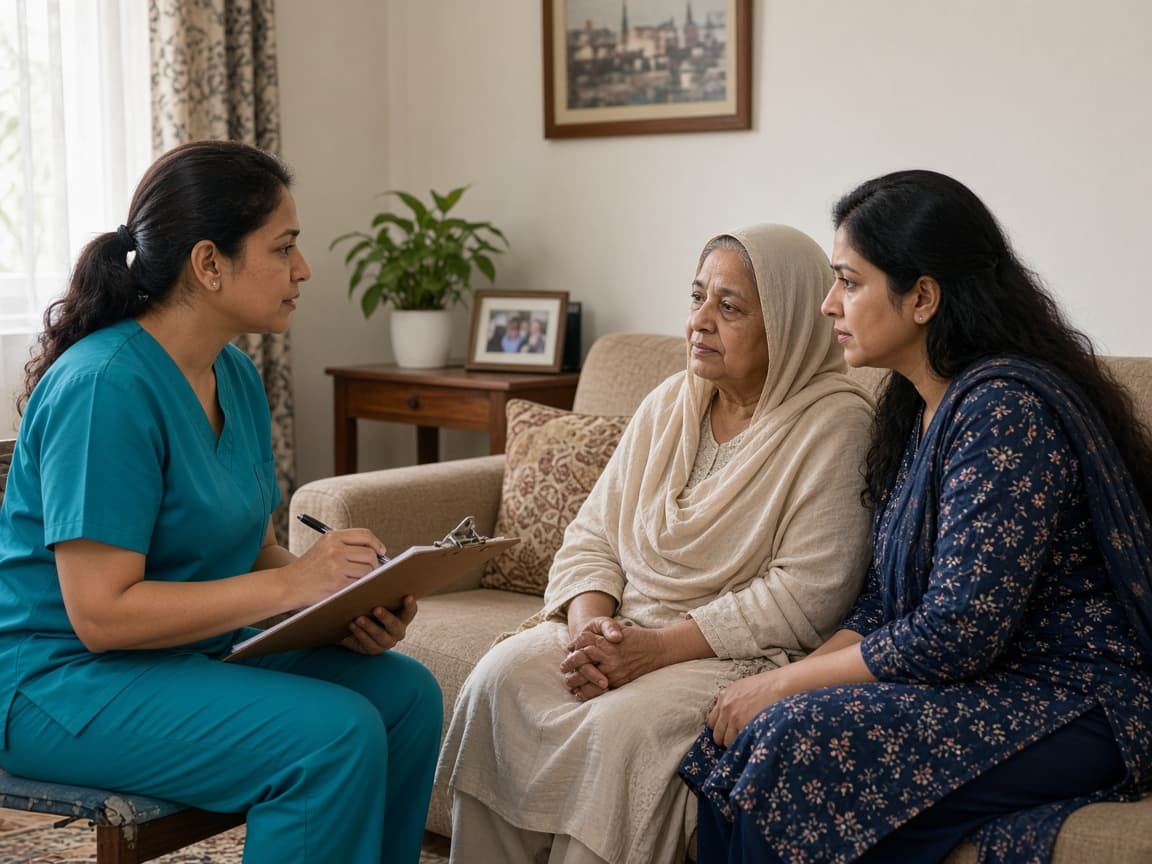
An occupational therapist looks at washing, dressing, the toilet, and the chair the person really uses. Those changes belong with occupational therapy at home. Physiotherapy, occupational therapy, and speech therapy answer different questions. Families do not have to choose one and abandon the others.
Ask the hospital which follow-up is booked, which movements are allowed, and which number to call if the weak side becomes more weak. Keep that number with the discharge paper. A calm week of supported sitting, protected shoulder, and real tasks is steady rehabilitation. A new neurological symptom is an emergency, and it should interrupt the routine immediately.